


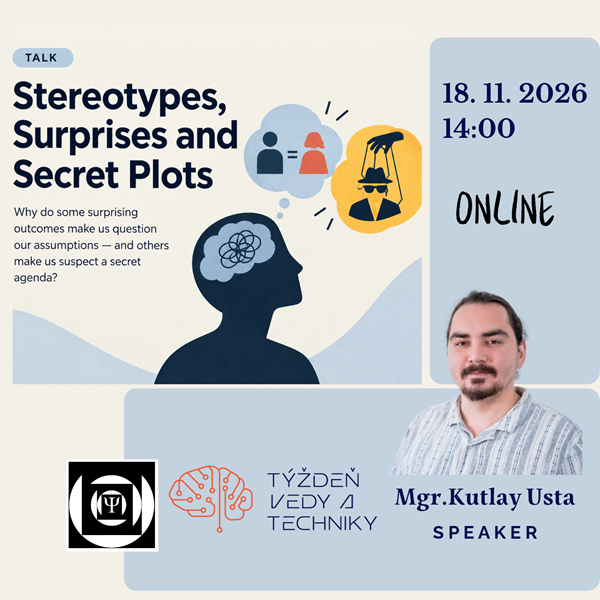
We invite you to a public online lecture: Stereotypes, Surprises and Secret Plots
Why do some unexpected events lead us to reconsider our assumptions, while others make us suspect hidden motives or secret plans? 🧠
Our PhD student, Kutlay Usta, will explore the psychological factors that may contribute to conspiracy thinking in everyday situations. We will examine the role of our expectations, deeply rooted stereotypes, and the search for a group to blame when things turn out unexpectedly.
📅 Date: 18 November 2026 (Wednesday)
🕒 Time: 14:00
💻 Location: Online – link coming soon
🎤 Speaker: Mgr. Kutlay Usta
📝 Registration: Please fill out this short registration form: https://forms.gle/aap3LjKxDcPnEF3E9
The lecture will be delivered in English.
Abstract:
We often assume conspiracy theories appear in crises like pandemics or terrorist attacks. But can they also grow out of ordinary moments? Imagine you're sure a man will get an engineering job, and an equally qualified woman gets it instead. You could rethink your assumptions, or decide something hidden must be going on, like a secret feminist agenda. My research asks when people take the second route. I expect it's most likely when the surprise is big, the stereotype runs deep, and there's a convenient group to blame. This talk will shed light on why these factors matter and how an unexpected outcome can lead us to question our assumptions—or to suspect that someone is secretly pulling the strings.
Views: 0